The Writers' Symposium Ezine
“Helping Writers Write”
Issue #3, June 2008
View the beautiful full color version with dozens of color pictures or download the PDF with all the good stuff at www.paulgenesse.com/writerssymposiumezine
To subscribe, or unsubscribe please email:
WritersSymposium@paulgenesse.com
Visit the Writers’ Symposium Blog at www.WritersSymposium.blogspot.com
===========================================
Contents
===========================================
From the Editor: Brad Beaulieu
Feature Article: Hook’em and Don’t Let Go
Featured Author Bio: Paul Genesse
Feature Article: Paul’s Favorite Books on Writing
Releases From the Writers’ Symposium
List of Current Writers’ Symposium Members & Contact Info
Final Thought
===========================================
From the Editor
===========================================
Hello and welcome to Issue 3 of the Writer’s Symposium Ezine. This is my first time in the editor’s seat, so I thought I’d introduce what we have coming up. In this issue we have an article of mine that first appeared in the Broadsheet, the newsletter from Broad Universe. For those of you ready to hunt for an agent, do not pass up this article.
Our featured author this issue is the inimitable Paul Genesse. Paul’s excellent debut book, The Golden Cord, has been out since April 15, and is doing incredibly well. This is due in no small part to the book signing and speaking tour—a swing through a number of western states—that Paul recently concluded. It also might have something to do with, well, the rocking story Paul wrote. Paul provided a few of his favorite books on writing, and we also have some small blurbs on recent appearances by the Writers’ Symposium authors. So, without further ado: please, read and enjoy.
Bradley P. Beaulieu, Editor
www.quillings.com
===========================================
Feature Article: Hook’em and Don’t Let Go by Brad Beaulieu
===========================================
Anyone who's been trying to sell novel-length fiction for any amount of time can tell you how quickly the rejections can stack up and how frustrating it can be to get someone to even look at your manuscript. If you're like me, you've submitted dozens of query letters hoping someone will at least ask for a few pages of the manuscript before handing you a rejection. I mean, that's fair, right--to at least look at the material before you reject it?
Trouble is, agents and editors receive many, many more queries than they can possibly accept. It's not uncommon to find agents receiving 75 queries or more per day. Can you imagine trying to read partials from them all? Impossible, especially when you consider they've got their normal work for their already-accepted clients to do as well. Like it or not, this is the state of publishing today, and I hope it brings to light the importance of the query letter. It is your chance, your two seconds, to say what you want before the door is closed, possibly with you still on the outside.
The goal of this article is to dig into the query letter and, more specifically, to focus on one crucial component called the hook. What is the hook? It's a single sentence placed in the opening of your query letter that sums up your entire work or (less commonly) gives some interesting bit of information about you. It is, by necessity, brief, and the reason should already be clear: agents do not have time to read every word of everything they receive. Many agents will not even read the whole query letter if your hook isn't compelling.
You may be tempted to belittle the importance of the hook, to gloss over it and move on to more "important" matters, but let me dissuade you against such thoughts. Gina Panettieri, of the Talcott Notch Literary Agency, states, "The hook is extremely important. Agents and editors are astonishingly busy people and a great number of queries and cover letters are thrown at them daily. When pressed for time, it's easiest for an overworked agent to try to make decisions based on reading as few words as possible." According to Ms. Panettieri, only about 10 percent of the hooks she reads make her sit up and take note. Another 20 percent catch her attention, but are not overly compelling. And the final 70 percent? No zing. No pizzazz. And, needless to say, the chances of the agent not finishing your query letter (much less asking for a partial) increase the more your hook fails to impress. And you certainly don't want to fall into this category: about 10 percent of the hooks Ms. Panettieri receives "... are just so general, I walk away with no clear picture of the project."
Ok, hopefully I've convinced you of the importance of the hook. Let's move on to brass tacks. One quick note: the concepts described below apply equally to an agent or an editor, but for brevity's sake, we'll use the term "agent" for both.
Let's discuss what not to do before moving on to what you should do. First, don't open by saying your novel is the next Harry Potter or that you're the next Anne McCaffrey. Better to open with a strong hook, because you'll only be putting the agent off with such grandiose statements. Let me be clear here: it's not a bad idea at all to compare your work to others in the market, but do your research. Find books that are similar to yours in style and tone. You can then compare and contrast to bring out your novel's strengths, and the agent will have a much better idea of where your book will stand in the market. And, to boot, their estimation of you as a businessperson will probably have been raised a notch or two in the process.
On a similar note, don't proclaim your book as a sure-fire best seller. What a statement like this really tells the agent is that you have unrealistic expectations, don't know the business, and may be hard to work with because of it.
Next, don't waste your hook on trying to be funny. Humor is very subjective, and too many people think they're funny when they're not. Heap on the fact that the agent may simply not be in the right mood for it, and it all adds up to a big no-no. I'll put my money on businesslike over funny any day.
Another ineffective (and, in my opinion, rude) technique cited by Ms. Panettieri is to quote glowing praise from another agent who has rejected your novel. Frankly, this is like handing your girlfriend a rose that has flecks of dung sprinkled on the petals. The agent can't exactly be enthused about a project that, by your own admission, has been rejected by someone else. Too, this technique implies that the agent wasn't your first choice: another annoying bit of information they don't need to know. Do they realize the novel might have been previously rejected? Yes. Do they know they might not have been the first agent you queried? Of course. But there's no need to put it in your query, no matter how glowing the prior rejection might have been.
Ok, let's move on to what you should do. You have a single sentence in which to describe your whole novel, right? Well, not exactly. What you're trying to do is to create buzz, to snag the reader's attention, to give them that intangible that will lure them onward. There are several choices to make when it comes to the hook's content, but it's all about putting your best foot forward. In other words, don't wait until the end or even the middle of the query letter before you present the hook; don't assume the agent will always read on to discover just how awesome your novel is. Open with your strong suit, right up front, and that will bolster the chance of them becoming compelled by the argument that you have a piece of work ready for publication. Your best asset might be your expertise in the subject matter of the work, or it might be prior publications (and most times these are preferable), but for a great many of us, the hook will be a summation of your story using its most unique facet, and that's what we'll focus on.
To do this, you must distill your story down to its essence, making sure to bring out its most unique facet as you do so. I'll illustrate with one of my own novels, simply because I have the hooks that progressed from, well, not-so-good to not-too-shabby. This novel was about a young painter who discovered a crystal that allowed him to read minds. I wrote a hook that had some merit, but it failed to focus on that one, unique aspect of the story that would snag the reader. In other words, I created a rather ho-hum hook:
A simple artist is thrown into the intrigues of an elite crime organization. The harder he tries to escape from his fate, the further he's pulled in.
See what I mean? Not only that, I used two sentences to do it. The hook did manage to capture protagonist, antagonist, and the general struggle at hand, but it fails to impress. There's nothing unique about this that the agent hasn't seen a hundred times or more already. She might have even seen it a few times that day!
My next attempt was little better:
The story is about a Victorian-era artist who battles the forces of organized crime to save family and country.
The only thing that really changed here is the addition of setting and an allusion to the stakes. It's a minor improvement, but it doesn't quite get the juices flowing, does it?
After this query letter had crashed and burned (by the way, up to this point I had received zero requests for partial manuscripts after sending out roughly fifty queries) I attended a short seminar on writing the hook. I finally understood the hook's primary goal is not to butter up the agent for the good stuff that's to come, it's to catch their attention immediately so that they have a reason to read on. With this in mind, I gave it one more shot:
The story is about an ambitious artist who must defeat the forces of organized crime before they discover his secret of capturing thoughts in his paintings.
Now, this is no masterpiece, but the hook now contains the most unique facet of my novel: the fact that the protagonist can capture thoughts in paintings. This, I had to admit, was probably something an agent would not see every day. To test the waters, I sent a revised query with little else changed to six agents and received four requests for partials. Not a bad change. (As an aside, to make sure your expectations are not falsely heightened, I sent a larger batch of queries some time later and received something closer to a 15% positive response as opposed to the 75% referenced above. This is a more realistic response for a good hook from an unknown writer.)
Let's move on to something you know more about. Let's try creating a hook for a movie instead: The Matrix. Let me suggest that you stop reading and try to come up with your own hook; see if you can come up with a single line to encapsulate The Matrix, making sure to bring out the film's most unique element(s).
What's unique about The Matrix? Well, there's the notion that the world is not real, that we're actually all slaves to the Matrix. What if we went with that? We'd want to bring Neo into the picture, somehow, and describe his realization of this staggering fact and perhaps give hint to his subsequent struggles. Remember, too, that we don't hide anything from the agent. We lead with our best asset.
Neo--corporate clone by day, hacker in cyberspace by night--discovers that the world around him is a facade, that the real world is a place where all humans save a precious few rebels are enslaved, and he must now decide what to do about it.
Or perhaps you think Neo's abilities in the Matrix are the most unique element. In that case, perhaps we'd end up with something like:
Neo begins a journey as a self-styled hacker in cyberspace, but as he discovers just how far his abilities in the Matrix extend, it ends with the realization that he's the key to saving humanity itself.
All right, one last go. Maybe you think that The Matrix is really a story about how love can overcome anything. We'd want to give some hint to the love that blossoms between Neo and Trinity even among the grime of "reality".
Neo never believed in true love, at least not until the mysterious and beautiful Trinity leads him to the other side of cyberspace.
These examples aren't exactly poetry, but I hope they shed enough light on the subject for you to continue the experiment with your own work. For added practice, continue this hook exercise with other novels or movies. Try to create hooks for a story you've just finished or a movie you've just seen. One source I can recommend is the Internet Movie Database. It doesn't have hooks, per se, but it does have movie poster taglines for newer releases. These taglines are similar to hooks in many ways. Read through those phrases and soak in the punch they're trying to deliver. Now go dig into your story, find that one element that's most unique or enigmatic or luminous, and incorporate it into your hook. Then hone it until its sharp enough to cut skin.
Comment on the article on the Writers’ Symposium Blog: www.writerssymposium.blogspot.com
===========================================
Featured Author: Paul Genesse
===========================================
A toy castle is probably what sent Paul Genesse over the edge. It may have been what led him to announce at the ripe age of four that he was going to be a writer.
During Paul’s days at Northern Arizona University he loved his English classes, but pursued his other passion by earning a bachelor’s degree in nursing science in 1996. He is a registered nurse on a cardiac unit in Salt Lake City, Utah, where he works the night shift keeping the forces of darkness away from his patients.
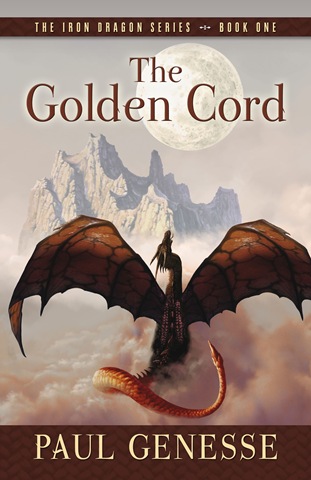
The Golden Cord, the opening book of Paul’s Iron Dragon Series came out in April of 2008 from Five Star Books features a cover by the amazing artist Ciruelo Cabral. The other four books in the series have already been written. Book one has already sold out of its first printing and the second printing is selling well.
Paul’s short stories include: Almost Brothers, the lead story in the Fellowship Fantastic anthology from DAW Books (2008); The Pirate Witch, in The Pirates of the Blue Kingdoms (May of 2007) from Popcorn Press; The Queen’s Ransom, published in Blue Kingdoms: Shades and Specters (October 2007, Walkabout Publishing) and The Mob in Furry Fantastic. Paul also has short stories in The Dimension Next Door (DAW, July 2008), Blue Kingdoms: Buxom Buccaneers (Walkabout Publishing, 2008), Imaginary Friends (DAW, September 2008), Catopolis (DAW, December 2008), and Terribly Twisted Tales (DAW, 2009).
Paul’s current project is Medusa’s Daughter, a fantasy set in ancient Greece. Read samples of his work at www.paulgenesse.com where you can watch a book trailer about The Golden Cord or see his Fox News TV interview.
===========================================
===========================================
The Golden Cord
The dragon king rises, and a hunter must leave behind the woman he loves, give up all hope of survival, as he is forced to guide his most hated enemies to the lair of the beast that threatens to enslave their world.
What the reviewers are saying about The Golden Cord by Paul Genesse.
“Book one of the Iron Dragon series is a rich and compelling fantasy full of adventure, danger, dragons, battles, revenge, magic, and more.” (full review below)
VOYA Magazine
Sara Cofer
“The Golden Cord is indeed a hellishly good read.”
The Pedestal Magazine
JoSelle Vanderhooft
“This debut novel promises to unlock a realm of magic and warfare in a unique world of cloud-bound lands and a mysterious Underworld.”
Library Journal, Jackie Cassada
Sara Cofer at VOYA Magazine writes:
The Golden Cord: Dragons and Griffins are not the only dangers facing Clifton, a secret village in Ae’leron. The Dwarves enslave humans for their armies, forcing them into hiding. Drake Bloodstone, Clifton’s most vigilant guardian, would do anything to protect his people from Aevians and Dwarves. Ridiculed for choosing to guard instead of hunt, Drake realizes his destiny as a hunter when two Dwarves arrive in Clifton. The Dwarves seek a guide who will lead them on a quest to find their lost kin. Drake feels it is his sacred destiny to escort the Dwarves and volunteers to be their guide. After a few days, Drake discoveres the Dwarves are hiding their true purpose. They reveal that while they are in search of their lost kin, they are also Dragon Hunters and are tracking Draglune, the King of Dragons and the most Ancient Evil, who will bring a great war that will end the world. Drake knows he must do everything in his power to help stop Draglune and save his people. Book one of the Iron Dragon series is a rich and compelling fantasy full of adventure, danger, dragons, battles, revenge, magic, and more.
Readers will root for Drake, a strong character who struggles both physically and mentally with the sacred duty handed to him. Drake is becoming a man while learning to follow his heart and trust his enemies in order to save everything he loves. The plot is well constructed, the characters are wonderful, and the middle-ages setting creates an ominous feel. The cliffhanger ending will leave readers eager for more of this great recommendation for fans of Lord of the Rings.
===========================================
Paul’s Favorite Books on Writing
===========================================
Self-Editing for Fiction Writers by Renni Brown and Dave King is an invaluable book for writers. It is packed with concrete examples of how to make your work of a professional quality. It helped me become a published author with a growing list of short stories and novels.
The First Five Pages by Noah Lukeman is a very practical guide to writing a good book. The advice he has is right on and helped me break into publishing. I applied his ideas to my first novel and it got the attention of several editors. This is a book that will really pay off.
How To Write A Damn Good Novel by James N. Frey is one of my favorite books on writing. The principles he teaches are incredibly powerful. They helped me so much as I wrote my first novel, which was subsequently accepted for publication. James N. Frey's advice is very insightful. I applied it to my own writing and made my books and stories much better. It's a quick read and worth adding to your collection--especially if you want to break into writing.
Characters & Viewpoint by Orson Scott Card is a definitive guide to the different forms of point of view (POV). Card describes each type of POV and their variations, and explains the strengths and weaknesses of each. I believe this is an incredibly important guide to beginning writers and even veterans wanting to gain more knowledge about certain types of POV.
Beginnings, Middle & Ends by Nancy Kress helps you start your book with a bang and then keeps the action going to the end. Too many books lag in the middle, or start slow. If you follow the advice presented, your novel will be much better. Her advice on hooks is worth the cover price. I liked the book a lot and have referred back to it several times as I went from newbie writer to published writer.
Comma Sutra: Position Yourself for Success with this grammar book by Laurie Rozakis Ph.D. I don’t think there are any other books on grammar as funny as this one.
Writers’ Symposium Member Releases
Editor, Kerrie Hughes has a new anthology with 13 brand-new stories about the realities just around the corner from our own, featuring stories by Paul Genesse, Brad Beaulieu, Don Bingle, Chris Pierson, Steven Schend and Anton Strout.
Brad Beaulieu’s short story, “Lest Our Passage Be Forgotten”, is in Realms of Fantasy. It’s a story about the Land of the Dead, about those still living, and the fireworks that connect the two. It came out in the March/April issue of the magazine. He also has a story called “No Viviremos Como Presos", which was picked up by Orson Scott Card’s Intergalactic Medicine Show releasing in late 2008.
Anton Strout’s novel, Dead To Me is an urban fantasy featuring a man working on the right side of law—with talents that come from left field. This just in: it’s very, very, very,
funny. And Ace books has given Anton a five book deal!
Luke Johnson is the editor and co-author of several gaming books. Check out his World of Warcraft book, Dark Factions. See all of his gaming related work at: www.lukejohnson.com
Imaginary Friends: Thirteen original tales of those companions—some human—some not, conjured from imagination in times of need. Featuring stories by Paul Genesse, Don Bingle, and the ghost editing of John Helfers.
The Fellowship Fantastic Anthology, edited by Kerrie Hughes, features stories by several Writers’ Symposium members: Paul Genesse, Don Bingle, Chris Pierson, Brad Beaulieu and the famous Alan Dean Foster.
Future Americas: Oh say can you see— sixteen original stories about the America to come. Sixteen authors have taken up the challenge of gazing into the future and seeing where America may be the day after tomorrow. Edited by John Helfers and featuring a story by Don Bingle.
Under Cover of Darkness, edited by Julie Czerneda and Jana Paniccia. The Prix Award Winning Anthology featuring Shadow of the Scimitar by Janet Deaver-Pack. From the true role of the Freemasons to Chronographers who steal pieces of time to an assassin hired by a group that reweaves the threads of history, here are fourteen imaginative tales of time and space and realms beyond our own-all watched over, preserved, or changed by those who work covertly under cover of darkness.
Future Wars edited by Denise, War—what is it good for? It’s good for 19 all-new tales from the battlefield...
Nineteen all-new tales that look at war from the perspective of everyone from human to alien, pixie to toy. From epic intergalactic struggles for the future of humankind to the microcosm of a single abandoned toy soldier in a boy’s backyard; from a chemical experiment gone horribly wrong to a young recruit who may hold the key to “understanding” the enemy; from a half-mortal knight trying to avert a war with the Elfin Host to a Battle of Trenton fought against seven-foot tall Saurians, Front Lines brings together a diverse array of imaginative explorations of the phenomenon of war. Featuring a story by Symposium member Don Bingle and others.
Dagger-Star, a novel by Elizabeth Vaughan was released in April from Berkly Sensation and has gotten excellent reviews. After captivating readers with her Chronicles of the Warlands trilogy, our very own USA Today Bestselling author, Elizabeth Vaughan now returns to that world with a beguiling tale of daggers and destiny, a cold and beautiful mercenary known as Red Gloves, and Josiah, a lone fighter emerging from the torched fields and razed farms of his homeland. All Josiah knows about the mysterious woman is her dagger-star birthmark, a sign that she is destined to free the people from a ruthless usurper's reign of terror.
The Name of the Wind by Patrick Rothfuss is now out in paperback and has become a New York Times Bestseller! It also won the prestigious Quill Award! Please visit www.patrickrothfuss.com for more about the book and the amazing author.
===========================================
Writers’ Symposium Members—Visit them on their sites or on the W.S. Blog
===========================================
Jean Rabe www.jeanrabe.com
Paul Genesse www.paulgenesse.com
Don Bingle www.orphyte.com/donaldjbingle
Brad Beaulieu www.quillings.com
Anton Strout www.antonstrout.com
John Helfers stonehenge@new.rr.com
Pat Rothfuss www.patrickrothfuss.com/blog/blog.html
Luke Johnson www.lukejohnson.com
Kelly Swails www.kellyswails.blogspot.com
Tim Waggoner www.timwaggoner.com
Elizabeth Vaughan www.eavwrites.com
Marc Tassin www.marctassin.com
Richard Lee Byers www.stonehill.org/rlb/
Steve Schend brainstormfront.livejournal.com/
Janet Deaver-Pack www.janetpack.com/
Daniel “Doc” Myers www.medievalcookery.com/
Download the PDF for the email address of the writers listed below.
Sabrina Klein
Kerrie Hughes
Linda Baker
Chris Pierson
====================================================
Final Thought
====================================================
Thanks for reading, and don’t forget: Gen Con is right around the corner. We have two full tracks of panels this year! Make sure to set aside some time to catch up on the great content being offered. To find out more, check out Jean Rabe’s page that describes all of the panels:
We hope to see you there! Look for the next ezine, the Gen Con Preview, in late July.
Brad Beaulieu, Editor
===============================================================
Thank you for reading the ezine. Please forward it to all your friends interested in writing or reading. Please visit the Writers Symposium Blog for more information on writing—and to interact with the members of the symposium. Thanks again!
www.writerssymposium.blogspot.com
Visit www.paulgenesse.com/writerssymposium
===========================================
General & Unsubscribe Info
===========================================
To subscribe, or unsubscribe please email:
WritersSymposium@paulgenesse.com
The Writers' Symposium Ezine © Copyright 2008
Helping Writers Write, except where indicated otherwise.
All trademarks are property of their
respective owners. All contents provided as is.
No express or implied income claims made herein.
This ezine may be accessed online at:
http://www.paulgenesse.com/WritersSymposiumEzine
To contact us with feedback, questions or praise, email
mailto:WritersSymposium@paulgenesse.com
Please feel free to use excerpts from this newsletter
as long as you give credit with a link to our page:
www.paulgenesse.com/WritersSymposiumEzine
===========================================
Bradley P. Beaulieu, Guest Editor
The Writers' Symposium Ezine is an opt-in ezine available by
subscription only. We neither use nor endorse the use of spam.
Thank you!